

ARTICLES
VISITING THE BALTIC
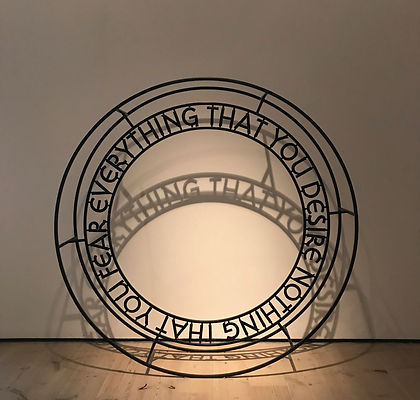
“This Machine Builds Nations” by Jasmina Cibic

“Missing Time” by Serena Korda
The BALTIC is an international centre for contemporary art based on the south bank of the River Tyne in the former Baltic flower mill building. It is the largest institution dedicated to contemporary art in the UK.
Opening in July 2002 the BALTIC hosts no permanent exhibitions, instead offering a frequently changing programme of exhibitions and events. Since opening, the BALTIC has presented over 204 exhibitions of work by 436 artists from over 58 countries and welcomed more than 7 million visitors.
The BALTIC's stated aim is to identify and support the most significant and challenging contemporary art from across the globe. Ranging from blockbuster exhibitions to innovative new work and projects created by artists working within the local community.
Their most recent exhibits are “Missing Time” by Serena Korda and “This Machine Builds Nations” by Jasmina Cibic.
Korda is the Norma Lipman and BALTIC Fellow in Ceramic Sculpture at Newcastle University. She used radio telescopes to explore the sounds of stars from the Northumberland skyline. This exhibit is a collection of ceramic dish-shaped portals that are used as sound resonators. Having worked with
sound healer Johanna Sheehan, sound engineer Fred Hollinsworth and local a cappella group Mouthful to create a piece that reverberates off the portals.
Korda has created a “powerful live performance that touches on invisible forces, consciousness and what lies beyond planet Earth”.
Cibic’s exhibit is a combination of film, installation and performance art looking in to ‘soft power’. It included a landscape image filled with photos from the archive of Yugoslavia’s first President Josip Broz Tito. As well as multiple films which examine the work of three different prominent architects
of the European Modernist era:
-
Vjenceslav Richter’s Yugoslav Pavilion built for the 1958 Brussels World Exposition
-
Arne Jacobsen’s City Hall, completed in 1942 during the Nazi occupation of Denmark.
-
Mies van der Rohe’s trade fair designs for Germany in the 1920s.
Cibic studies how each piece of work played a role in forming national representation of decisive political moments in European history.
“Cibic’s projects and films present a synthesis of gesture, stagecraft and re-enactment, revealing the strategies employed for the construction of national culture”.
In answer to the question of representing the artistic styles/themes and techniques favoured by local artists in Newcastle, the BALTIC chooses to focus not on the art around them geographically but searches for artists and exhibits on the forefront of contemporary art world.
the BALTIC manifesto, describes their objectives as showcasing “important and innovative contemporary art in a unique setting, which encourages and enables learning and transformational thinking”.
what about the biscuit factory?
This is neither a restaurant nor a factory where people make biscuits, although you can find a cafe in which you can have a break during the tour.
Born in 2002, the Biscuit Factory is a contemporary art gallery, the largest commercial art gallery in the UK. Its name seems to reflect the contemporary shade of the artistic objects made by local and national artists.
But what does the Biscuit Factory offer and why do people like it?
From paintings to sculptures, from ceramics to furnitures and jewellery, the Biscuit Factory proposes original objects for the home and for the self.
Being original and unique pieces, who would not like to have an object that no one else has? This is probably the main strength of this gallery: the unicity of artistic objects of any kind and different sizes which anyone can buy - though not necessarily afford.
The Biscuit Factory currently offers three exhibitions (from the 2nd of March to the 20th of May 2018): the Spring Exhibition, the Print&Press Exhibition, and the Botanical Collection. The two pictures on the right are part of the Spring collection, accurately chosen for the current season.
However… Why should a cat be included in the Spring Collection? We asked Lavonna, 25 years old, from Texas. She said that despite being a bit random, this painting might actually have a deeper meaning other than just being a cat with a mouse. She suggested it could be the circle of life between the life (the cat) and the death (the mouse).
"The Art that I've seen from Newcastle usually has to do with something historical like films, bridges (...)." Lavonna thinks that this painting is quite distanced from the Art one usually sees in Newcastle, which, according to her, is a more traditional and historical city rather than a contemporary one.
The Ocean Flow is an oil on canvas recently created by by John Brenton.
"A lot of people from Newcastle have this sort of fascination with the sea and it is an important aspect for them". Lavonna says this painting speaks more to Newcastle or the North-East in general. In comparison to "cat with mouse", this seems more traditional and despite being very recent, she feels like this could be from the Renaissance and it is closer to Newcastle's art.
Sometimes it does not matter when a specific artistic object was created. The connection with a specific city like Newcastle might differ depending on what is portrayed or on the feeling of the viewers: we all see things differently, Art included.

"Cat with Mouse" by Henrietta Corbett

"The Ocean Flow" by John Brenton
back to a more traditional one: the laing art gallery
Founded in 1901 by Newcastle businessman Alexander Laing the Laing Art Gallery hosts a varied collection of art and sculpture. Rather than filling the gallery with pieces from his own collection, Alexander Laing chose to rely on the generosity of the people of Newcastle at the turn of the 20th century to supply pieces of work in order to encourage the natural development of art in the region.
Over 100 years on, the gallery still receives voluntary donations to aid funding from organisations such as National Art Collections Fund, Heritage Lottery Fund and invaluable support from the Friends of the Laing Art Gallery. Their support has allowed to gallery to expand and now strikes a balance of international works of art, and historic pieces originating from the north east, whilst still giving local people an opportunity to showcase their own photographs, films and stories.
The collection at the Laing predominantly focusses on British oil paintings, watercolours, ceramics, silver and glassware. Including work by 19 th century artists such as William Holman Hunt, Lawrence Alma-Tadema and John Martin. Martin, is particularly interesting as the gallery displays a group of painting by the artist who was born and brought up in the North East.

"Alpheus and Arethusa" By John Martin
Northern Spirit is a permanent exhibition at the gallery. Designed to celebrate the achievements of local artists, manufacturers, and designers from the local area. Opening in 2010, the exhibit features work from painters including Martin, as well as 18 th century engraver and naturalist Thomas Bewick.
The Laing and City library hosts a variety of paintings, drawings, woodblocks, copperplates and wood-engravings by Thomas Bewick or his apprentices. In addition the gallery also displays pieces of work by the Beilby family of glass enamellers. As well as collecting historic works of art by North East based creators. The gallery has worked with the International Centre for Culture and Heritage Studies at Newcastle University to examine the relationships between art, identity and place. Local people’s photographs, films and stories are displayed on touch-screen computers. Giving visitors an insight in to the evolution of art in the North East.

"Grainger Street, Newcastle Upon Tyne" by Louis Hubbard Grimshaw
The Laing does well to create exhibitions which cover a range of artistic periods, styles and methods of expression. As well as bringing a rotating set of exhibits presenting art from across the world to Newcastle. The gallery ensures that visitors experience a sense of the history of the city itself, through paintings of well-known areas in Newcastle from across history, we are able to see how the city has developed. But artefacts such as plates, glasses and engravings which were all built in the North East. These pieces allow visitors to explore the cultural heritage of industry and production in the area in a way a painting does not communicate.
In addition to the awareness of the city’s history, the Laing’s work to digitally display modern work from local photographers and videographers the Laing’s understanding for the need to stay in tune with the artistic scene in Newcastle at a grassroots level. But also acknowledges the changing ideas of art, in the past photos and videos may not have been considered art. But now you can see local
examples at one of the biggest galleries in Newcastle.
IS PUBLIC ART WORTH THE Investment? A conversation
That’s the question facing Clare Rogers, director of estates at Newcastle University, every day. And it’s a question she’s more than happy to answer with an enthusiastic nod of the head and a smile that makes me feel sheepish for asking in the first place. Clare (who admits that while her business is buildings, the acquisition of art is a hotly pursued hobby) is evidently passionate about creating art on campus.
As she tells us, the University makes around half a billion pounds every year. And after our eyes had finished widening and we’d remembered to reclose our mouths, she continued that it seems a discrepancy that so little of those seemingly cavernous coffers has historically been spent on art.
Before the shiny new bronze of Martin Luther King Jr. was unveiled late last year, the last work officially commissioned by the university was the Herschel building’s Spiral Nebula in 1962.
So why the gap? For an establishment with the top Fine Art department in the country it seems a 55-year oversight that so little was done in this regard. Clare agrees, stating the obvious benefits from funding these projects. Students can often be seen taking photos of public arts and politicians and ambassadors frequently visit to view the MLK sculpture. So it’s hardly wasted money. Clare started working at the University in 2000 and began buying pieces of art from student exhibitions, leading to the institution of the palindromic bridge to Robinson library and various sculptures in the Devonshire building. The pleasingly named Coherent Campus was alliteratively created and commenced to contribute cold cash to creative campaigns of cohesive landscaping.
Later the Art on Campus group was formed. These are who are responsible for the three large heads directly in front of the Armstrong building being bought for our sitting pleasure. When asked what the process for this acquisition was, Clare happily admits that there is no real procedure. While the lack of a uniform practise for the intake of art has led to several projects being scuppered due to individual taste, she believes this is the better way to go about things. Anything goes. Any style. “As soon as you start decreeing what you will or won’t have, you’ve killed it”. There have been some recent advancements, she encourages. Sir Antony Gormley, creator of a small piece of local sculpture you may be familiar with named The Angel of the North, has agreed to lend an original work to the university for five years. The tall statue has just been approved with planning permission and will stand directly in front of the student union. Clare hopes the uni will quickly warm to the work and purchase it when the trial period is up.
In April 2018, the aforementioned Art on Campus group received a particular remit and blessing from the university’s executive board to work as a more formal group. Clare says she would love to celebrate more of Newcastle University’s own art professors. While these people are always working and creating, their works are most commonly condemned to the basements of the art buildings and she is extremely interested in bringing this outside for people to enjoy.
So as far as the university goes, it appears things are looking up. While the Art of Campus team are currently doing what they can to celebrate themes of people, culture and nationalities, Clare hopes that a proper remit and budget can change the landscape of an institution that’s been, for too long, kept out of the publicly creative loop.

